WHEN DOES A MASK BECOME CONTEMPORARY ART?
What defines a contemporary mask artist?
To address the term “mask artist” versus “mask maker,” I should say first that this is not ‘craft versus fine art’ argument. That would be kind of embarrassing, frankly. I use “mask artist” because it feels broader to me. It encompasses all forms of mask making without assigning value to one over another.
Masks already occupy a strange territory. They are ancient, ubiquitous, culturally loaded objects tied to ritual, performance, transformation, and spectacle. They are never, ever neutral.
A contemporary mask artist approaches the mask as an object in and of itself. Once that happens, the definition begins to open. It begins to buckle, swell, and lose its edges. Looking through online repositories of contemporary mask work like Fashion for Bank Robbers and False Face, it becomes obvious very quickly that a mask can take almost any form - or none that stays stable for long. For example, Olivier de Sagazan, a French artist, has a piece, “Transfiguration,” which defines the intentional instability in this regard. The piece begins with the artist’s head covered in thick layers of clay and paint and ends after multiple variations of animalistic faces are sculpted directly onto the clay during the performance.
Wearability is no longer the point. Sometimes the work was never meant to be worn at all. The mask can exist as sculpture, image, relic, artifact. The mask can function as a stand-alone work rather than a tool in service of something else.
That shift is part of what defines contemporary mask practice for me - the idea that the mask no longer has to justify itself through an overarching use, whether ritual, cultural, or ceremonial. The mask just is. And it is allowed to be, is encouraged to be. It is pushed to be.
From traditional mask making to contemporary practice
Traditional mask making is often rooted in cultural and ritual use, whether in ancient ceremonial practices or in forms as specific and living - as truly alive - as the mesh masks of the Courir de Mardi Gras. Contemporary practice can absolutely draw from those histories, but drawing from them is not the same as inheriting a fixed role and function from them. It is also not a judgement on value - one is not better or more important than the other. The shift is simply one of orientation.
In traditional practice, the mask often belongs to an established symbolic system. It has a role, a use, a place within a larger structure. In contemporary practice, that structure loosens. The mask becomes more open to personal language, material experimentation, and conceptual tension and pressure.
WHAT MAKES A MASK “CONTEMPORARY”?
The underlying question here is, “When does a mask stop functioning in the category of ‘mask’, and begin functioning as contemporary art?” There is no hard line or checklist, nor should there be. Still, certain tendencies do begin to appear.
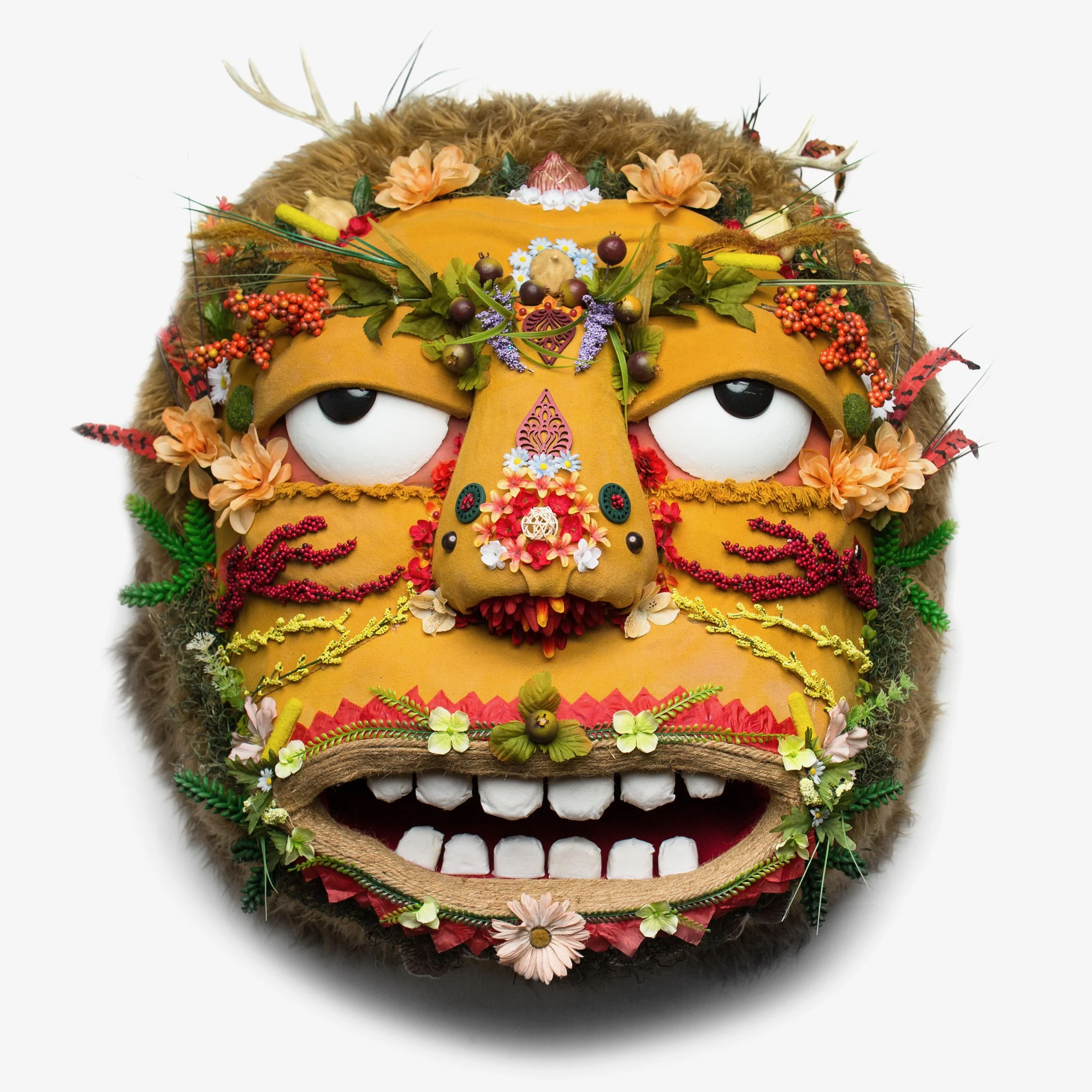
To me, the physical form itself is the first indicator. The mask starts to exceed the face. It moves outward. Into sculpture, into image, into objecthood, into something harder to easily categorize - it becomes a spectrum between several different points. It may still be wearable, but again - wearability is no longer the point, and utility usually becomes irrelevant.
Material begins to behave differently, too. The mask no longer answers only to tradition, utility, or finish. It becomes more open to visual pressure: textiles, found objects, plastics, hair, trim, paper, metal, whatever can be made to hold weight, symbolic or otherwise. The material does not simply decorate the form. It helps destabilize it and again, it becomes a spectrum. Has the material now become the form in certain areas of the mask? Or has the form entered the material ?
The symbolic structure loosens as well. The contemporary mask can draw from ritual, religion, folklore, theater, carnival, fashion, pageantry, the grotesque - but it does not need to remain fixed within any single one of those worlds. It can and does borrow and distort, hybridize, rebuild.
That, to me, is where the shift becomes most visible. The mask stops simply serving a known role and begins asking to be read on its own terms. It de-anchors itself from its womb of culture, ritual, ceremony.
ONE APPROACH AMONG MANY
My own work sits in one corner of this field. I tend to approach the mask as what I call a hybrid devotional form: part sculpture, part ritual object, part character.
I draw from Catholic iconography, carnival, adornment, devotional imagery, pageantry, bodily ornament, and especially the point where the embellishment starts to outgrow the structure it was meant to serve. That threshold matters to me. It is where decoration stops behaving like decoration. It opens up and pushes past itself.
I am not very interested in the mask as disguise, honestly. I cannot even pinpoint a moment in my studio where that factor entered my head, much less the decision-making process. I want it to feel encountered. Something charged, something overbuilt. Maybe even a little unstable and unruly. Something with its own logic and temperament rather than something that simply sits there to be looked at. I’m happiest with my work when it is less like an accessory to a body, and more its own body and mind - when it seems to have crossed over into a life of its own.
WHY CONTEMPORARY MASK ART MATTERS
Contemporary mask art matters because the mask remains one of the most charged forms we have. It does much more than conceal. It can distort, exaggerate, amplify. It can turn the face into symbol, fiction, relic, character, idol. The list goes on.
That matters because the mask allows artists to work at a threshold that few forms reach so directly: between body and object, self and performance, ritual and invention, inherited meaning and personal symbolism. The contemporary mask can carry all of that at once without needing to resolve it. Maybe that is why the form still feels so alive. That sense of contained tension with zero attempt to flatten it. With contemporary mask art, instead of flattening, it pushes. It pushes in the other direction, widening it and expanding the definition of “mask” along with it. It pushes to expand the tension, to expand the definition of 'mask.’
The mask is ancient, yes. But it is not finished with us.